Writing an Education Plan Rationale
Issued on 12 Mar 2026 by

Nova Scotia Career Development Association
Issuer
Nova Scotia Career Development Association
training@nscda.ca
NSCDA: on the cutting edge of best practices, innovation, industry standards and professional certification for career development professionals.
Criteria
Type of recognition
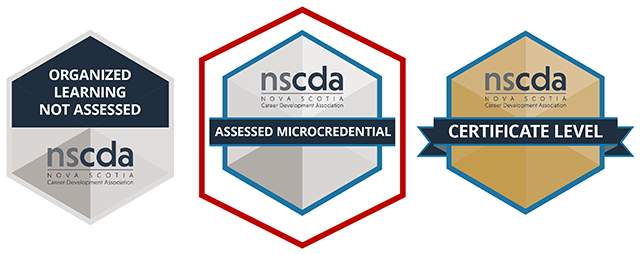
Assessed microcredential
Learning Objectives/Outcomes
- Recognize core elements of effective writing in case work, such as being clear, concise, accurate, and objective.
- Base all communications to or about a client on a foundation of respect, acceptance and trust.
- Demonstrate effective writing skills in writing the Education Plan Rationale.
- Understand the meaning and purpose of Action Planning.
- Utilize correct grammar, spelling and sentence structure.
Learning Content
For case workers, writing is a primary means of communication. The learning content reviews critical aspects of effective writing, then focuses on specific tasks including writing about barriers and the education plan rationale. The demonstration of competence requires the learner to write an education plan rationale based on an authentic case study and addressing three key components:
Learning Experience, Activities
Learners work through a series of self-paced courses and reflective activities, then write a rationale based on a case study, to support a client’s action planning. The rationale summarizes the client’s barriers to employment and clearly indicates how the intervention will eliminate, or greatly reduce, the obstacles which are preventing the individual from obtaining and maintaining suitable employment.
Assessment
Written submission must contain the following:
- Clear overview/summary of the client’s situation;
- Be clear, concise, accurate, objective and respectful. Spelling and grammar are also evaluated.
- Response to the following:
a)What prevents the client from obtaining sustainable employment with their current occupational skills?
b)What process has the client gone through to explore employment options? Be sure to address each of the four employability dimensions.
c)How will the intervention recommended resolve the client’s employability needs?
An instructor reviews the assignment and provides written feedback. Learners may be asked to resubmit if they do not meet the assignment criteria.
Estimated learning effort
4.5 hours

Alignments
The National Competency Profile for Career Development Professionals
https://cdpc-cedc.ca/our-profession/national-competency-profile/
The National Competency Profile for Career Development Professionals (National Profile) is a curation of competencies from the Competency Framework that details and describes effective performance, knowledge, understanding, and abilities for ALL Career Development Professionals regardless of role/setting.