Case Management
Badge awarded to
Nichole Goguen
Issued on 05 Dec 2025 by

Nova Scotia Career Development Association
Issuer
Nova Scotia Career Development Association
training@nscda.ca
NSCDA: on the cutting edge of best practices, innovation, industry standards and professional certification for career development professionals.
Criteria
Type of recognition
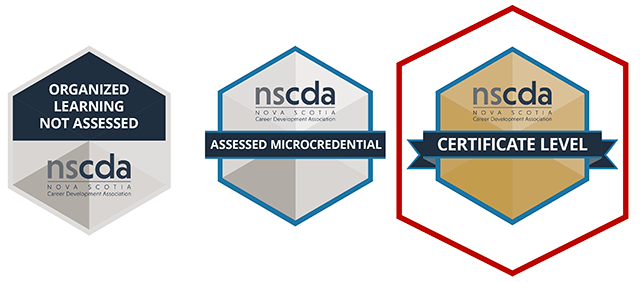
Assessed Learning, Certificate Level
Certificate requirements
- Completion of all courses within the eight modules, including achieving a pass on all embedded assessments.
- Successful completion of the Needs Assessment video assignment (Module 3), which is evaluated by an instructor and feedback given. The assignment must receive a 'pass' by the Instructor and results in the earning of the Needs Assessment: Foundations Microcredential.
- Successful completion of the Barriers assignment (Module 5). The assignment must receive a 'pass' by the Instructor and results in the earning of the 'Writing in Case Management' microcredential.
- Successful completion of the final assignment (Module 8), which is based on a case study. This comprehensive assignment requires the demonstration of learning from the case management training, including case conceptualization, decision-making and prioritizing, identifying and describing employment barriers, determining interventions, developing an action plan and writing case notes.
Learning Content
Each module comprises a series of short courses that incorporate a range of approaches, including presentations, readings and learning activities. All integrate strategies for learner engagement.
Module 1: Case Management in Career and Employment Services
Module 1 provides an orientation to the training and introduces case management both in the context of career development practice and as a distinct skill set. In the employment services setting, case managers are typically also career development practitioners, and this module outlines the competencies required of each role.
At the end of this module, learners will:
- Have a general overall understanding of the Case Management Training.
- Define Career Development Practitioner and Case Manager, and explain the relationship between the two roles.
- Identify and discuss the core competencies required of a Case Manager.
- Assess personal strengths as a Case Manager and identify areas for further development.
- Begin or add to a Professional Development Plan.
Module 2: Communication Skills and Developing a Working Alliance
Module 2 focuses on the core communication skills required to establish rapport and build a working alliance. These skills are the foundation of case management and include nonverbal, verbal and listening skills as well as the core elements of building a working alliance – rapport, confidentiality, collaboration, trust, and giving feedback.
At the end of this module, learners will:
- Understand and practice critical components of good communication skills, including nonverbal, verbal and listening skills.
- Recognize and appreciate cultural diversity and inclusion.
- Demonstrate an understanding of the core elements of building a working alliance, including rapport, confidentiality, collaboration, trust, and feedback.
Module 3: Needs Assessment
Module 3, the Needs Assessment, is the heart of the Case Management Specialization. In it, the communication skills learned and practiced in Module 2 are applied to conducting a needs assessment. Concepts covered in Module 3 include introductions and confidentiality, the Employability Dimensions, strategies for effective questioning, and the needs assessment interview/conversation. A recorded video assignment is submitted for evaluation.
At the end of this module, learners will:
- Understand the levels of needs assessment and the purpose of each.
- Demonstrate effective questioning skills.
- Be aware of and understand five employability dimensions.
- List the general components of a needs assessment interview.
- Identify client strengths.
- Identify employment barriers/challenges.
- Be able to introduce yourself to a client and review confidentiality.
- Conduct an effective needs assessment interview/conversation.
Module 4: Career Development Essentials
Module 4 builds on the needs assessment, continuing with next steps in the case management process including case conceptualization, decision-making, and making referrals; and addressing the case management competencies of community connections, co-ordinating interventions, and advocacy.
At the end of this module, learners will:
- Use information gathered in a needs assessment to conceptualize a case.
- Be familiar with the steps of decision-making and the ethical decision-making model.
- Apply judgment and decision-making skills in prioritizing employment barriers.
- Understand case conferencing and its benefits.
- Integrate the skills of case conceptualization, prioritizing and decision-making in summarizing a case for case conferencing.
- Comprehend essential components of coordinating interventions, including community connections, making referrals and advocacy.
- Be able to identify employability dimensions and interventions to address specific client barriers.
Module 5: Writing for Case Management
In Module 5, the focus shifts to one particular element of case management – writing. Module 5 reviews critical aspects of effective writing, then focuses on specific case management tasks including writing about barriers, action planning, and writing emails and case notes. This module includes the submission of a written assignment.
At the end of this module, learners will:
- Know the meaning and purpose of the action plan.
- Recognize core elements of effective writing in case management, such as being clear, concise, accurate and objective.
- Identify your own strengths and areas for growth in relation to writing skills.
- Base all communications to or about a client on a foundation of respect, acceptance and trust.
- Demonstrate effective writing skills when describing employment barriers.
- Demonstrate effective writing skills in writing case notes and e-mails.
Module 6: Additional Skills for Case Managers
Module 6 examines three additional skill areas. Time management, working with challenging clients, and saying ‘no’ to clients while maintaining a working alliance are all critical to effective practice and are covered here.
At the end of this module, learners will:
- Implement strategies for developing time management skills.
- Identify personal strengths and areas for growth related to time management.
- Understand client reluctance or resistance and recognize the signs of a reluctant or resistant client.
- Recognize disruptive behaviours.
- Use strategies for working with resistant clients and disruptive behaviours.
- Demonstrate the skills of saying ‘no’ to a client while maintaining a working alliance.
Module 7: Case Closure
Module 7 explores the final stage in the case management life cycle, Follow-Up. It also includes a review of case closure and strategies for working with returning clients.
At the end of this module, learners will:
- Understand the process of closing a client’s case
- Be familiar with possible reasons for closing a client’s case
- Understand how to discuss case closure with clients
- Recognize the purpose and value of follow-up
- Be aware of strategies for working with clients who are in a cycle of not completing their action plan successfully and continuing to return for services.
Module 8: Assignment
Module 8 comprises a final, comprehensive assignment based on a simulated client scenario. Participants must review a needs assessment video and related documentation, analyze the case then complete case notes, identify and describe barriers, determine possible short and longer-term interventions, and write an action plan including these components. Upon successful completion of the eight modules, including the three submitted assignments (Modules 3, 5 and 8), learners are awarded the Case Management Specialization Certificate.
Learning Experience, Activities
The self-paced online learning plan includes reading text, viewing videos, and accessing articles to review. Reflective activities and knowledge check questions are embedded throughout.
Assessment
Assessment is both formative and summative. All modules contain embedded assessments/knowledge checks that must be passed for the learner to progress in the training. In addition, the learner must complete assignments in Modules 3 and 5 - a video assignment in Module 3 and a written assignment in Module 5 - earning the two respective microcredentials. Finally, the learner must, in Module 8, complete a comprehensive assignment based on a case study, demonstrating case management competencies including case conceptualization, decision-making, prioritizing, identifying and describing employment barriers, determining interventions, developing an action plan and writing case notes.
The three assignments are reviewed and evaluated by an Instructor who provides feedback and completes an evaluation form based on a rubric. The evaluators will look for evidence of the areas covered in the training: case conceptualization, decision-making and prioritizing, identifying employment barriers, determining interventions, developing an action plan, and effective writing skills (employment barrier descriptions, case notes).
Learners are provided with feedback on both areas of strength and areas for further development, but overall, they must achieve an 'acceptable' level of competence to pass the assignment.
Learners must pass all components to be awarded the final Certificate-Level Microcredential for Case Management Training.
Estimated learning effort
This learning plan will take approximately 6 months to complete.

Alignments
The National Competency Profile for Career Development Professionals
https://cdpc-cedc.ca/our-profession/national-competency-profile/
The National Competency Profile for Career Development Professionals (National Profile) is a curation of competencies from the Competency Framework that details and describes effective performance, knowledge, understanding, and abilities for ALL Career Development Professionals regardless of role/setting.