Foundations of Belonging in the Workplace
Badge awarded to
Kelli Gordon-Skinner
Issued on 15 Oct 2026 by

Nova Scotia Career Development Association
Issuer
Nova Scotia Career Development Association
training@nscda.ca
NSCDA: on the cutting edge of best practices, innovation, industry standards and professional certification for career development professionals.
Criteria
Type of recognition
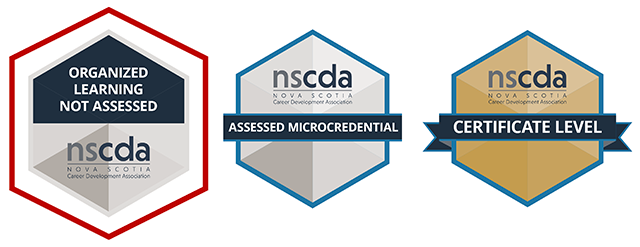
Organized Learning Not Assessed
Learning Outcomes
At the end of this learning plan, learners will:
- Have a foundational awareness of Nova Scotia’s colonial history and current labour force inequities, while gaining context for the importance of this learning, strategies for engaging in uncomfortable growth, and an appreciation for the evolution of inclusive language.
- Understand how biases are formed, recognize their impact in workplace and community settings, and apply strategies to identify, challenge, and mitigate bias at personal, organizational, and systemic levels.
- Recognize the impact of privileged aggressions in the workplace, understand how they manifest in various contexts, and apply respectful strategies for accountability, repair, and response.
- Understand the relationship between biases and stereotypes, examine their causes and impacts in the workplace, and apply strategies to disrupt stereotypes through individual behaviour change.
- Understand privilege, power, and intersectionality, including how these concepts relate to race, white privilege, and systemic racism.
- Have an increased awareness of disability, accessibility, and ableism through exploring real workplace experiences, examining systemic barriers, and identifying practical actions to create more inclusive and accommodating work environments.
- Develop the skills to engage in culturally humble and effective cross-cultural communication by exploring personal cultural lenses, recognizing diverse communication styles, and practicing respectful, responsive approaches to cultural traditions and differences.
- Comprehend meaningful allyship and its active role in creating workplace impact, recognizing the importance of accountability and responsible action.
- Recognize the role of human-centred leadership in driving cultural and workplace shifts in Nova Scotia.
- Understand the importance of psychological safety and belonging in the workplace and apply strategies to foster inclusive environments that respect diverse working styles.
- Advance organizational change by learning how to influence transformational DEIB efforts, understanding the value of data and metrics, and creating a personal call to action to sustain meaningful progress beyond the training.
Learning Content
Module 1: Introduction and Acknowledgement
“If you don’t know where you've come from, you don't know where you're going,” (Maya Angelou). this module helps learners start a reflective learning journey with diversity, equity, inclusion and belonging, let’s go back in time to understand how Nova Scotia’s colonial and discriminatory past has contributed to present-day discrimination and inequities in society and at work. We will prepare you to embrace the uncomfortable and unknown as an opportunity to grow and get the most out of this course.
Module 2: Disrupting Bias
Our brains process thousands of data points a day and are designed to group and label things out of necessity. When unexamined these labels, groupings and beliefs can become extremely problematic, hurtful and limiting - leading to harmful outcomes in the workplace. But there are solutions. This module will introduce learners to the scope of our biases, how and why they happen, how they cause harm, and what we can do about them.
Module 3: Privileged Aggression
Though typically coined as ‘micro’, aggressions have a harsh and insidious impact on those with equity-seeking or historically excluded identities. For this reason and to take ownership of the harm we cause (when we benefit from a societally-privileged identity), we call them Privileged Aggressions. This reminds us that we have a duty to dissect how our own power, biases and actions can contribute to a harmful culture for others.
Module 4: Stereotypes
Showing up as the shared and unfair overgeneralizations we make about groups of people, stereotypes hold a close relationship with our biases. In this module, learners will explore that relationship, the impact of stereotype threat and what we can do to enhance our conscious thinking to disrupt these harmful preconceived ideas that limit our ability to more fully understand and connect with others.
Module 5: Privilege and Power
We all hold a degree of privilege and power that impacts how we move through and interact with the world. In this module, learners will explore how privilege and power intersect to grant social and economic advantages that benefit some and create systems of oppression for others. We will take this further by discussing white privilege and the steps we can take to adopt an anti-racist lens within ourselves and our organizations.
Module 6: Creating Accessible Workspaces
Understanding the experiences of, and barriers faced by People Living with Disabilities, helps us rewire our biases, revise our thinking and champion more accessible workplaces. An inclusive Nova Scotia is one where everyone has ample opportunity to succeed in reaching their fullest potential at work. This module was created in partnership with TEAM Work Cooperative, a Nova Scotia Works Employment Services Centre, and features experiences shared by Nova Scotians living with disabilities.
Module 7: Leading with Humility in Cross-Cultural Communication
“Remember, it is not our differences that divide us. It is our inability to recognize, accept and celebrate those differences,” (Audre Lorde). In this module, learners will gain a deeper understanding of your own cultural lens, and how to de-center yourself as an approach to more effective cross-cultural communication. They will learn about the different cultures and traditions practiced in Nova Scotia and how they can express cultural humility to appreciate the differences in communication patterns across cultures.
Module 8: Allyship in Practice
People often hope for a checklist of the dos and don'ts of allyship. What to say, and what not to say. We're not going to give you a checklist and there is no allyship certification. For learners, this module is intended to serve as a self-reflection on their allyship journey to date and will prompt them to lean into the unlearning and relearning that is necessary when seeking to work in solidarity with equity-deserving groups.
Module 9: Becoming a Leader is Diversity and Belonging
Being a leader in diversity, equity, inclusion and belonging means holding yourself and others accountable to the promises that are being made to rectify wrongs. It means reflecting on and challenging the notion that ‘this is how it’s always been done.’ And it means exercising your personal power to help others feel seen, heard and valued in their fullness. Anyone can develop leadership traits to mobilize more inclusive and equitable outcomes in the workplace, in this module, learners will be shown how to exercise their personal power to become that leader.
Module 10: Creating a Culture of Belonging at Work
When people feel the pressure to conform or ‘fit in’ at work, it creates dire consequences for both individuals and teams. How do you foster a team of people that are intrinsically different, but who align with your vision, the why, the how and the what, that makes your company tick? This module will lead learners through an examination of healthy strategies for fostering a culture of belonging and psychological safety, which are crucial for employees to feel connected to both work and community.
Module 11: Influencing Organizational Change
The issues of inequity within an organization are systemic. They are entrenched in the processes and policies and therefore require shifts and dismantling at the organizational level. This module takes learners on a journey to understand what transformational organizational change could look like for your workplace. We take an evidence-based and informed approach to understanding organizational change, so learners can effectively and meaningfully determine their role in that change.
Learning Experience, Activities
The self-paced online learning plan includes reading text, viewing videos, and accessing articles to review. Reflective activities are embedded throughout.
Assessment
This is a Completion-Based Certificate with no summative assessment of learning.
Estimated learning effort
9 hours

Alignments
The National Competency Profile for Career Development Professionals
https://cdpc-cedc.ca/our-profession/national-competency-profile/
The National Competency Profile for Career Development Professionals (National Profile) is a curation of competencies from the Competency Framework that details and describes effective performance, knowledge, understanding, and abilities for ALL Career Development Professionals regardless of role/setting.