Career Transitions
Badge awarded to
Nichole Goguen
Issued on 30 Jul 2026 by

Nova Scotia Career Development Association
Issuer
Nova Scotia Career Development Association
training@nscda.ca
NSCDA: on the cutting edge of best practices, innovation, industry standards and professional certification for career development professionals.
Criteria
Type of recognition
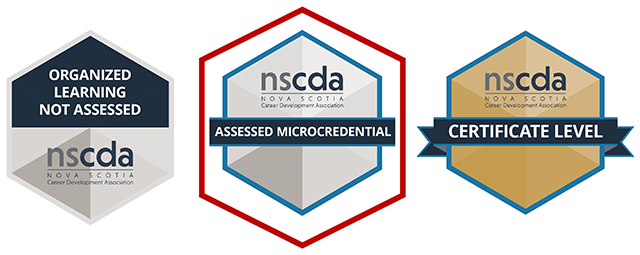
Assessed microcredential
Learning Outcomes
- Understand the complexity of career transitions and the impacts of job loss.
- Identify the 5Rs of Culture Change and describe how they are applied to the concept of transition stress.
- Recognize the stages of Bridges Transition Model.
- Identify the Five Stages of Grief and describe how they relate to job loss.
- Identify variables that can impact how clients respond to job loss and career transition and factors which can impact diverse groups who face their own unique challenges.
- Identify strategies to support clients through the three stages of Bridges Transition Model.
- Recognize indicators that a client may be ‘stuck’ in the Job-Loss Cycle.
- Use reframing techniques to help shift clients' perspectives.
- Prepare clients for interviews and answering questions related to their job loss.
- Understand the impact of prolonged job loss and the additional stages of stagnation, frustration and apathy.
- Appreciate the necessity to maintain professional boundaries and make referrals when clients’ needs are outside your scope of practice.
- Define ethics and understand the guidelines in the Code of Ethics for Career Development Professionals.
- Resolve an ethical dilemma using the Ethical Decision-Making Model.
- Define compassion fatigue and be aware of self-care strategies.
Learning Content
Course 1: An Overview of Career Transition
In this course, learners will explore the complexities of career transitions and the impact of job loss on individuals. You will learn about the 5Rs of Culture Change and how they apply to transition stress, as well as the physiological, emotional, and behavioural effects of job loss, including the five stages of grief. The course examines the job loss cycle, factors influencing client responses, and the unique challenges faced by diverse groups. You will be introduced to Bridges Transition Model and learn practical strategies for supporting clients through various stages of grief and the job loss cycle. By the end of the course, you will have a comprehensive understanding of the multifaceted nature of career transitions and the specific challenges associated with job loss.
Course 2: Supporting Clients Through Career Transitions
In this course, learners will explore strategies to support clients through career transitions, with an emphasis on the job loss cycle. You will learn how to assist clients as they navigate the three stages of Bridges Transition Model—Endings, the Neutral Zone, and New Beginnings—using targeted strategies and interventions. The course will review indicators that a client may be 'stuck' in the Job-Loss Cycle and how to apply reframing techniques to help shift their perspectives. Additionally, you will explore practical strategies for preparing clients for interviews and addressing questions related to their job loss. The course will also examine the impact of prolonged job loss and offer insights on adjusting job search strategies for extended unemployment. By the end of the course, you will be equipped with the skills to support clients effectively through the complexities of job loss and career transitions.
Course 3: Ethics and Ethical Decision Making
In this course, learners will examine the ethical and professional considerations essential for Career Development Practitioners. You will learn how to maintain professional boundaries and recognize when to make referrals if a client's needs extend beyond your scope of practice. The course reviews the principles outlined in the Code of Ethics for Career Development Professionals and introduces the Ethical Decision-Making Model, including a practical example to apply its eight-step process. Additionally, the course addresses the impact of supporting clients through career transitions, focusing on compassion fatigue and the importance of self-care. You will gain strategies to manage compassion fatigue, build resilience, and ensure your own well-being while providing effective support
Learning Experience, Activities
The self-paced online module includes reading text, viewing videos, and accessing articles to review. Reflective activities and knowledge check questions are embedded throughout.
Assessment
The learning outcomes are evaluated by a 50-question multiple-choice assessment with a requirement of 80% to pass.
Estimated learning effort
4 hours

Alignments
The National Competency Profile for Career Development Professionals
https://cdpc-cedc.ca/our-profession/national-competency-profile/
The National Competency Profile for Career Development Professionals (National Profile) is a curation of competencies from the Competency Framework that details and describes effective performance, knowledge, understanding, and abilities for ALL Career Development Professionals regardless of role/setting.